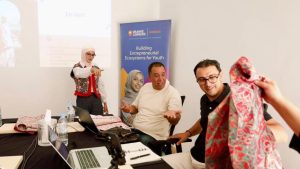
Originating in South Africa, Orange Corners plays a central role in strengthening the South African entrepreneurial ecosystem. We closely collaborate for this with the NL Embassy in Pretoria, the Dutch Consulate-General in Cape Town and local partners, such as the Orange Corners South Africa and Orange Corners Designs teams. In this ecosystem mapping, this team looks at current challenges and opportunities for entrepreneurship in South Africa.
The ecosystem analysis highlights both persistent structural barriers and emerging opportunities across six domains of change: infrastructure, access to finance, effective policy, business environment, entrepreneurial learning, and culture. The conclusion? Entrepreneurs continue to face unreliable energy and internet access, spatial inequality, limited funding opportunities, low financial literacy, and a policy environment that often favours established firms. Across the business environment, early-stage ventures struggle to access markets, support mechanisms vary in quality, and chronic cash flow challenges hinder growth. Entrepreneurial learning remains overly theoretical, while cultural perceptions, especially in townships and among women, limit participation in entrepreneurship.
Yet these challenges coexist with substantial opportunities. In infrastructure, demand for renewable energy solutions, logistical innovations, and workspaces is rising. In finance, guarantee schemes, entrepreneurship sensitisation, and improved financial literacy offer promising avenues to strengthen investment readiness. The broader ecosystem also shows momentum toward collaboration, improved market access for small-scale sellers, and increased visibility of entrepreneurial role models. Educational institutions are showing greater openness to collaboration, while cultural shifts, supported by success stories and community engagement, create pathways for more inclusive entrepreneurial participation.
These findings have several implications for current Orange Corners programming. Ensuring stable access to energy, internet, and workspaces remains essential. Embedding financial literacy and business fundamentals into programmes, strengthening linkages with funders, and providing clearer guidance on compliance and certification will improve investment readiness. Advancing policy literacy and advocating for the inclusion of early-stage entrepreneurs in policy dialogues will help address regulatory barriers. Enhancing collaboration with universities, TVETs, and other ecosystem actors, while promoting success stories more proactively, will strengthen entrepreneurial learning and cultural acceptance of entrepreneurship as a viable career path.
The analysis also informs a set of strategic programming recommendations. Planned initiatives such as the Agripreneurship Project and the Twin Transition Challenge emphasise green, practical, and ecosystem-aligned solutions. Policy dialogues will focus on bridging the gap between policy and entrepreneurial realities, amplifying young entrepreneurs’ voices. The Green Knowledge Centre and TVET K2K initiative aim to strengthen entrepreneurial learning and mindset development by fostering connections with educational institutions and Dutch partners. All proposed interventions require strong linkages with existing Orange Corners programmes, OC Trust, combi tracks, impact clusters, and broader ecosystem initiatives.
Together, these insights and recommendations provide a roadmap for enhancing Orange Corners’ impact in South Africa, deepening ecosystem collaboration, strengthening entrepreneurial pathways, and reinforcing entrepreneurship as a driver of inclusive and sustainable economic growth.

research